> ## Documentation Index
> Fetch the complete documentation index at: https://docs.cloudthinker.io/llms.txt
> Use this file to discover all available pages before exploring further.
# Leaderboard
> Understand the Developer Leaderboard scoring formula that balances code quality with productivity.
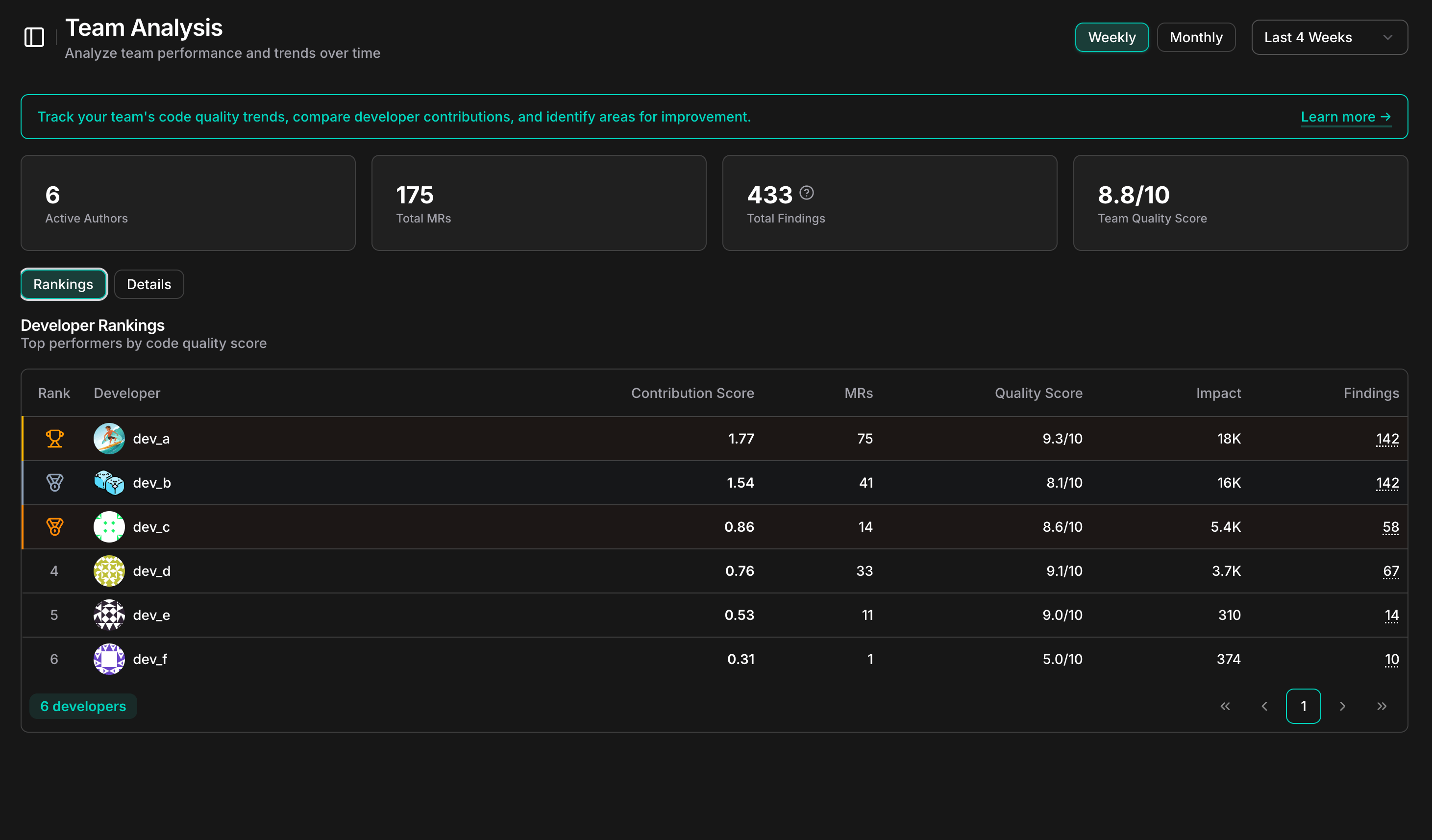
The leaderboard scores each developer by balancing **Quality** (AI review scores) and **Impact** (code complexity), so it rewards engineers who ship robust code, not just those who ship the most lines. Find it under **Code Review → Leaderboard** once your team has a few reviewed PRs.
 ## Why the leaderboard
* **Team-relative scoring** — both metrics are normalized against your own team's average, so scores stay meaningful in your context
* **Balanced assessment** — quality and impact contribute equally (50/50), so high-volume output can't mask low-quality work
* **Fair comparison** — large refactors count proportionally more than trivial changes
* **Quality incentives** — the 1–10 Quality Score turns code review into a positive feedback loop
* **Diagnostic, not just a ranking** — it surfaces workload imbalances and quality trends that PR counts alone don't show
## Quality score
Each PR receives a **Quality Score** on a 1–10 scale. The score starts at 10 and is reduced by the number and severity of findings — critical issues carry a higher penalty than low-severity ones. The **Team Quality Score** shown on the dashboard is the average across all developers.
## Core formula
```text theme={null}
Contribution Score = (Normalized Quality Score + Normalized Impact Score) / 2
```
Where:
* **Normalized Quality Score** = Author's Average Quality Score / Team Quality Score
* **Normalized Impact Score** = Author's Total Impact / Team Average Impact
| Contribution Score | Label | Interpretation |
| ------------------ | ----------------- | -------------------------------- |
| ≥ 1.5 | Excellent | Significantly above team average |
| 1.0 – 1.5 | Good | Above team average |
| 0.8 – 1.0 | Average | At or near team average |
| \< 0.8 | Needs Improvement | Below team average |
A score of exactly **1.0** means the developer sits exactly at the team average.
## Impact calculation
Each merge request's impact score measures the complexity of the change:
```text theme={null}
MR Impact = (files_changed × 6.0) + (lines_added × 0.14) + (lines_deleted × 0.28)
```
| Metric | Weight | Rationale |
| -------------- | ------ | ------------------------------------------------------------------ |
| Files Changed | 6.0 | Cross-file changes indicate higher complexity |
| Lines Added | 0.14 | New code requires understanding and integration |
| Lines Deleted | 0.28 | Deletions often require more careful analysis (2× addition weight) |
| Minimum Impact | 1.0 | Floor value to prevent division issues |
The impact formula is derived from the [Oobeya GitWiser Coding Impact Score](https://docs.oobeya.io/gitwiser-repo-analytics/git-analytics-metric-definitions/coding-impact-score) methodology.
## Example calculation
**Team data:**
| Author | Avg Quality Score | Total Impact |
| ------ | ----------------- | ------------ |
| Alice | 8.5 | 450 |
| Bob | 7.2 | 280 |
| Carol | 9.0 | 120 |
**Team averages:**
* Team Quality Score = (8.5 + 7.2 + 9.0) / 3 = **8.23**
* Team Avg Impact = (450 + 280 + 120) / 3 = **283.33**
**Alice's Contribution Score:**
* Normalized Quality = 8.5 / 8.23 = **1.03**
* Normalized Impact = 450 / 283.33 = **1.59**
* Contribution Score = (1.03 + 1.59) / 2 = **1.31**
Alice scores **1.31** — 31% above the team average.
## Reading the leaderboard
Use the score combinations as a diagnostic for engineering health, not just a ranking:
| Pattern | Signal | Action |
| -------------------------- | -------------------------------------------------------- | ---------------------------------------------------------- |
| High Quality + High Impact | Top performer | Ideal mentor, lead reviewer, or owner of complex refactors |
| High Impact + Low Quality | Possible burnout — shipping fast, cutting corners | Check workload and deadlines |
| High Quality + Low Impact | May be stuck on a hard problem or under-utilized | Check task allocation |
| Uneven Impact distribution | High "Bus Factor" — knowledge concentrated in one person | Redistribute knowledge and workload |
Review the leaderboard weekly to track quality trends and workload balance across your team.
## Related
See per-developer proficiency across Security, Performance, Correctness, and Patterns domains
Track code review trends, developer performance, and team health over time
## Why the leaderboard
* **Team-relative scoring** — both metrics are normalized against your own team's average, so scores stay meaningful in your context
* **Balanced assessment** — quality and impact contribute equally (50/50), so high-volume output can't mask low-quality work
* **Fair comparison** — large refactors count proportionally more than trivial changes
* **Quality incentives** — the 1–10 Quality Score turns code review into a positive feedback loop
* **Diagnostic, not just a ranking** — it surfaces workload imbalances and quality trends that PR counts alone don't show
## Quality score
Each PR receives a **Quality Score** on a 1–10 scale. The score starts at 10 and is reduced by the number and severity of findings — critical issues carry a higher penalty than low-severity ones. The **Team Quality Score** shown on the dashboard is the average across all developers.
## Core formula
```text theme={null}
Contribution Score = (Normalized Quality Score + Normalized Impact Score) / 2
```
Where:
* **Normalized Quality Score** = Author's Average Quality Score / Team Quality Score
* **Normalized Impact Score** = Author's Total Impact / Team Average Impact
| Contribution Score | Label | Interpretation |
| ------------------ | ----------------- | -------------------------------- |
| ≥ 1.5 | Excellent | Significantly above team average |
| 1.0 – 1.5 | Good | Above team average |
| 0.8 – 1.0 | Average | At or near team average |
| \< 0.8 | Needs Improvement | Below team average |
A score of exactly **1.0** means the developer sits exactly at the team average.
## Impact calculation
Each merge request's impact score measures the complexity of the change:
```text theme={null}
MR Impact = (files_changed × 6.0) + (lines_added × 0.14) + (lines_deleted × 0.28)
```
| Metric | Weight | Rationale |
| -------------- | ------ | ------------------------------------------------------------------ |
| Files Changed | 6.0 | Cross-file changes indicate higher complexity |
| Lines Added | 0.14 | New code requires understanding and integration |
| Lines Deleted | 0.28 | Deletions often require more careful analysis (2× addition weight) |
| Minimum Impact | 1.0 | Floor value to prevent division issues |
The impact formula is derived from the [Oobeya GitWiser Coding Impact Score](https://docs.oobeya.io/gitwiser-repo-analytics/git-analytics-metric-definitions/coding-impact-score) methodology.
## Example calculation
**Team data:**
| Author | Avg Quality Score | Total Impact |
| ------ | ----------------- | ------------ |
| Alice | 8.5 | 450 |
| Bob | 7.2 | 280 |
| Carol | 9.0 | 120 |
**Team averages:**
* Team Quality Score = (8.5 + 7.2 + 9.0) / 3 = **8.23**
* Team Avg Impact = (450 + 280 + 120) / 3 = **283.33**
**Alice's Contribution Score:**
* Normalized Quality = 8.5 / 8.23 = **1.03**
* Normalized Impact = 450 / 283.33 = **1.59**
* Contribution Score = (1.03 + 1.59) / 2 = **1.31**
Alice scores **1.31** — 31% above the team average.
## Reading the leaderboard
Use the score combinations as a diagnostic for engineering health, not just a ranking:
| Pattern | Signal | Action |
| -------------------------- | -------------------------------------------------------- | ---------------------------------------------------------- |
| High Quality + High Impact | Top performer | Ideal mentor, lead reviewer, or owner of complex refactors |
| High Impact + Low Quality | Possible burnout — shipping fast, cutting corners | Check workload and deadlines |
| High Quality + Low Impact | May be stuck on a hard problem or under-utilized | Check task allocation |
| Uneven Impact distribution | High "Bus Factor" — knowledge concentrated in one person | Redistribute knowledge and workload |
Review the leaderboard weekly to track quality trends and workload balance across your team.
## Related
See per-developer proficiency across Security, Performance, Correctness, and Patterns domains
Track code review trends, developer performance, and team health over time