

Using this page with CloudThinker. Paste this page’s URL into a chat and try: “Explain how scoring works here”, “Quiz me on proved versus guessed findings”, or “Plan our three graded attempts across two rounds”.
Rules of the room
- 150 minutes, seven blocks. The clock is on the board, and it is the only clock that matters.
- Read-only. The agent can inspect the environment. It cannot change anything, and it cannot read secrets.
- You never enter credentials. You join with your team’s code, and the environment is operated for you.
- Your team recommends. Nothing executes. Every change in a report is a proposal with a named owner.
- One to four people per team. One laptop is enough; everyone sees the same report and the same board.
- Your team name is yours. After you join, Rename in the header changes it and the board follows within the second. A name another team already has is refused, and you can always go back to the name you arrived with.
- Redact before you share. Account IDs, endpoints and anything identifying a real system come out first.
How the day runs
Round 1 is scored across the five Well-Architected lenses: cost, security, performance, reliability, operations. Round 2 is scored on the chain from the symptom to the resource whose configuration changed, plus the response you recommend. One hundred points, and nothing else is deducted.
Scoring
The judge is an AI agent, and it grades the report as written: three runs, median score. Every attempt comes back with a total and a short note, so the second attempt can be aimed at what the first one missed. It will never tell you the answer, the gaps or the root cause, and it will not look at the environment for you. Write for a reader who cannot see your screen, because that reader holds the points. In Round 2 you do not see your own score either: the board shows that a team submitted, and the number stays locked until the reveal.
The clock forces a decision a longer round hides. Submit an honest first version early, then spend the rest of the block making it stronger. A team that writes until the last minute submits once, with no feedback to work from.
What a report needs
Every claim is worth exactly what backs it. Ask three questions of every line, then label it the way you did on Day 01:
Findings are not capped, and the judge rewards quality over volume. One finding you proved beats five you guessed at, and a report that names its own gap scores better than one that hides it.
Check in before the round opens
Everything happens in the Arena at arena.cloudthinker.io. Join with your team’s code during the community share, not while Round 1 is being read out.1
Enter your team code
Open arena.cloudthinker.io and enter the code your team was given under Join your team. The code is also on the slide.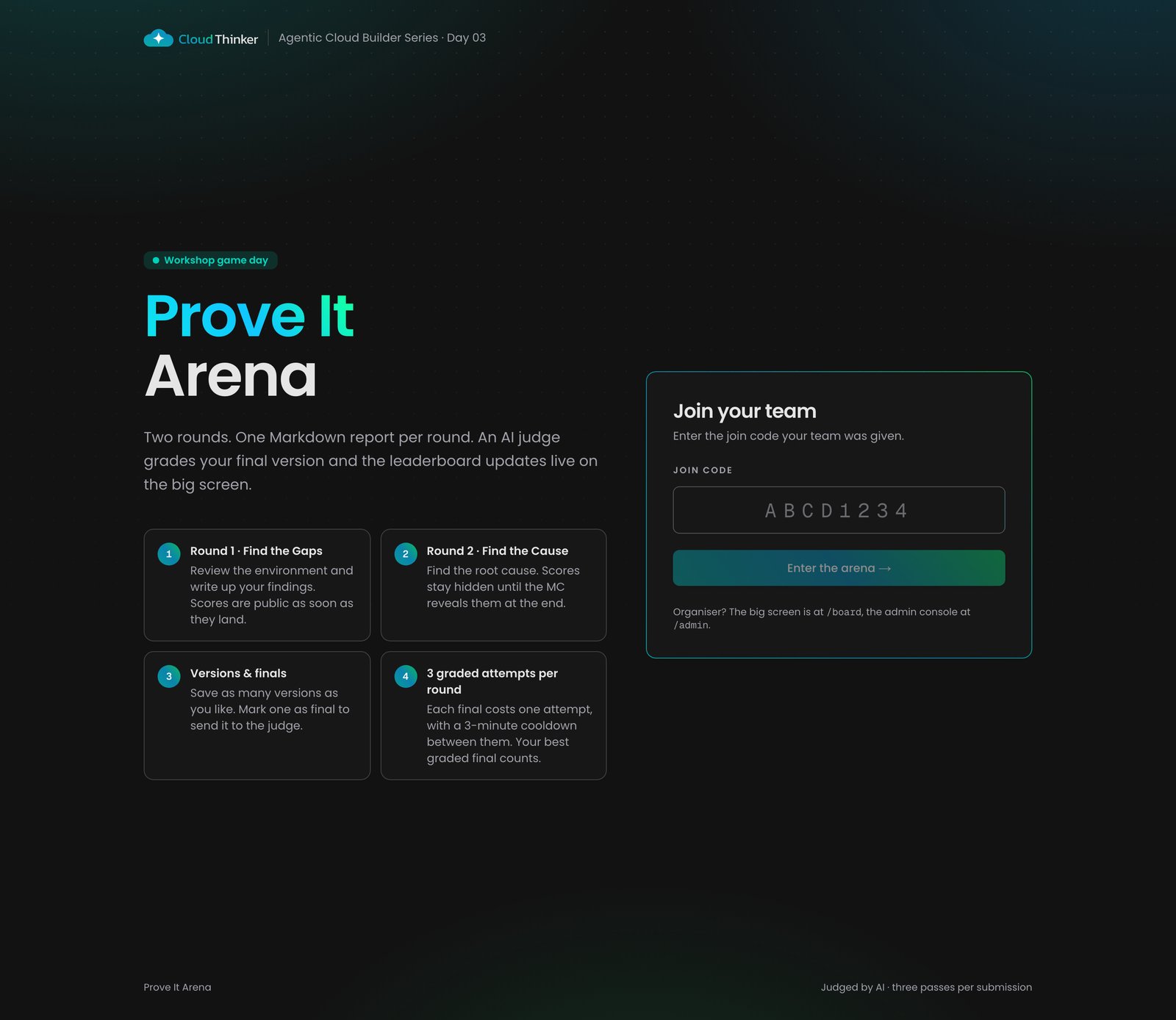
The Arena home page: the rules of the day and the code field
2
Watch the board while you wait
The board carries every team, the running total and the clock. It is the same screen the room is watching.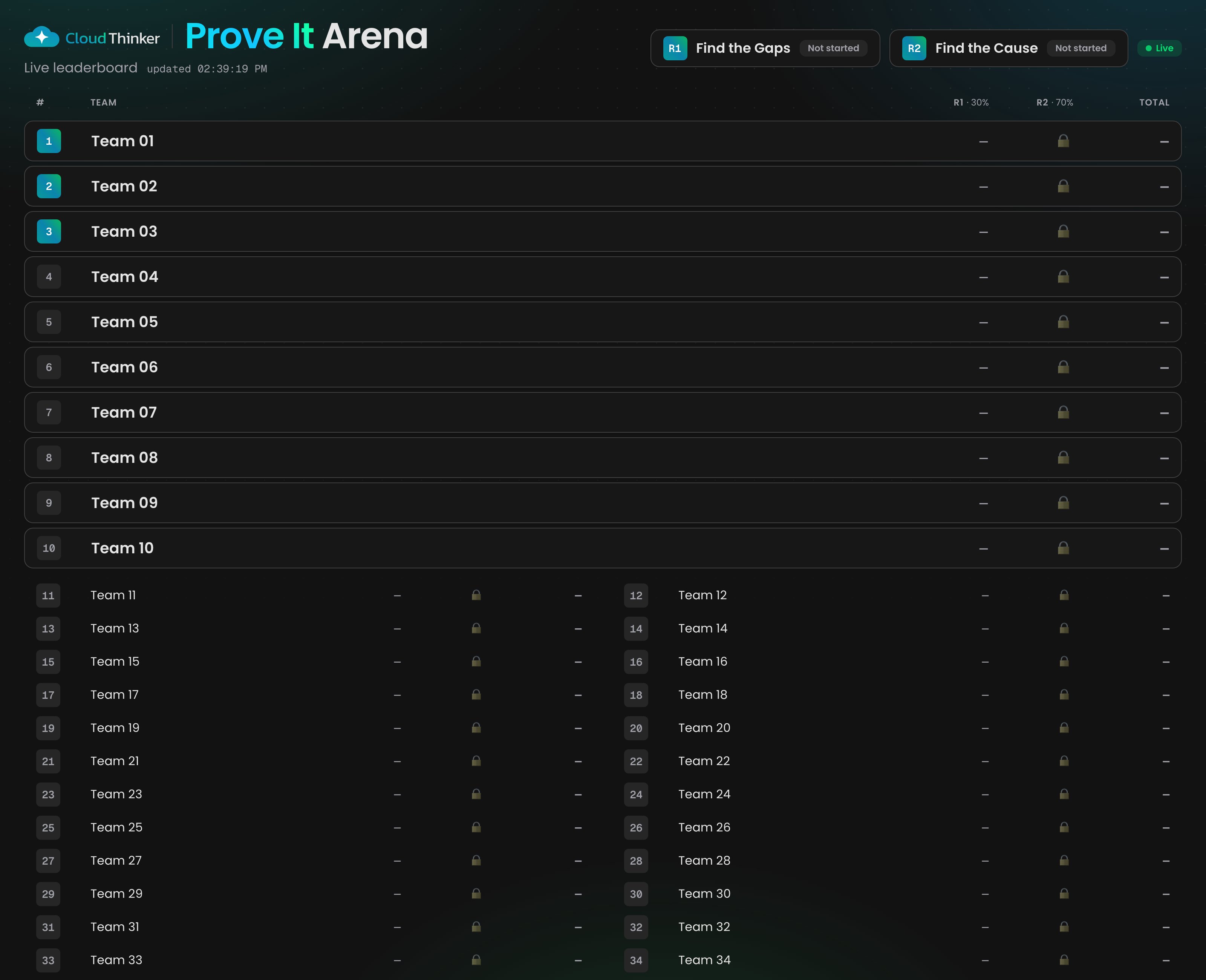
The board, before the first round opens: one row per team
3
Open your round page
It lists the round, its length and the attempts you have left. It refuses a report until the organisers open the round, so nothing sent early is counted.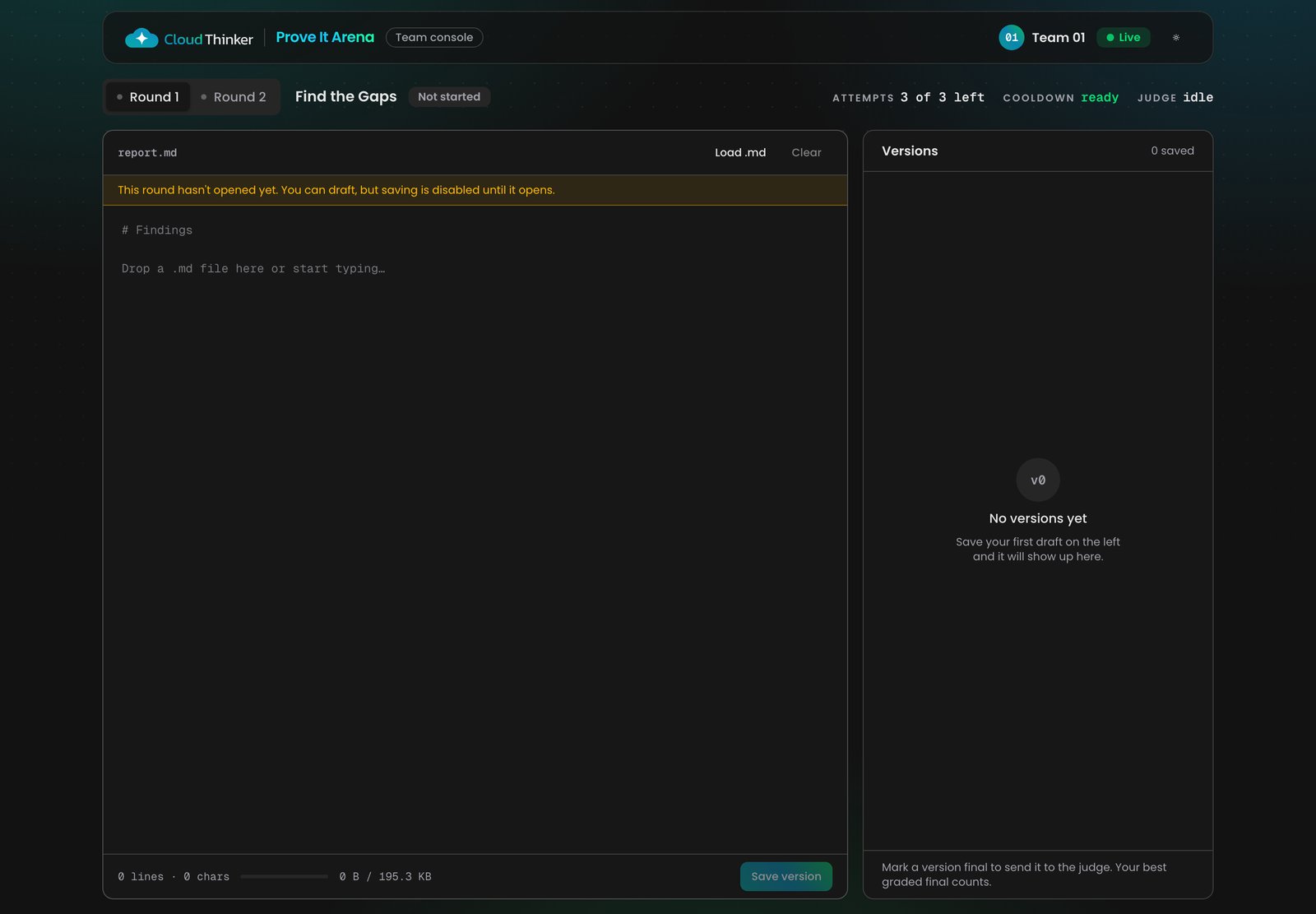
The round page: the editor, the versions and the attempts left
Community share · 30 minutes
Three teams present a report from Day 01 or Day 02, ten minutes each, one from each city. They were chosen before the day, not volunteered on it, and the report is the artifact on screen. Watch how they use evidence rather than which service they found: that is what the judge reads from your team within the hour.Round 1 · Find the Gaps
The task: an unfamiliar cloud environment, 25 minutes, 30 points, and a board that updates in public as the scores land. Say what is worth fixing and prove it with evidence. Finding out what a good review looks like is part of the task.- Everything looks fine. Ask what is unusual here compared with a default environment, rather than what is broken.
- The agent hands you a long list. Ask which single item it would fix first, and what proves it. A list is not a finding.
- The agent cannot read something. That is a blocked scope line in block 01, and a good result.
Round 2 · Find the Cause
The task: a customer is affected, 45 minutes, 70 points, and a board that will not tell you how you are doing. Build the causal chain from the symptom to the resource whose own configuration changed, then recommend the response.
Nothing a report proposes is applied to the environment, so the response is scored as a recommendation with a name on it: what to change, who approves it, and what you would check afterwards to show it worked. A response that names a symptom and stops there reads as a guess.
- Everything is healthy. Healthy dashboards are part of the exercise. Ask what the users are seeing.
- One confident cause arrives immediately. Ask for the rival explanation, then for the reading that separates the two.
- You run out of time. Submit what you have. A report that ends with “insufficient evidence” and shows the log is complete.
Reveal and close · 20 minutes
The board opens at once, both rounds together, and the ranking lands before anyone explains it. Then the reveal walks the two environments: what was there to find, what the highest reports showed, and where a confident report went wrong. Round 2 is the one worth watching. Every team had the same symptom, the same read-only access and the same clock, and the answers differ. That spread is the point of the day. Each region then names its Prove It Champion and Runner-up.What comes next
- Teams that complete all three days keep three portfolio artifacts and the series skill certificates.
- Outstanding finalists may be selected for the three-month CloudThinker Ambassador Program.