The Problem
Modern cloud infrastructure sprawls across multiple accounts, regions, and providers. Teams have no single source of truth for what’s running, what it costs, whether it’s secure, or how it’s connected. The result:| Problem | Reality |
|---|---|
| Invisible resources | Resources provisioned for projects that ended — still running, still billed |
| No dependency map | When something breaks at 3 AM, nobody knows what depends on what |
| Reactive security | Misconfigurations discovered in audits or breach notifications, not proactively |
| Point-in-time assessments | Well-Architected reviews happen once a year, findings go stale immediately |
| Manual operations | Engineers spend hours on repetitive cost reviews, security checks, and tagging |
What’s Included
Resources
Live inventory of every cloud asset — discover, filter, tag, and act on resources across AWS, GCP, and Azure
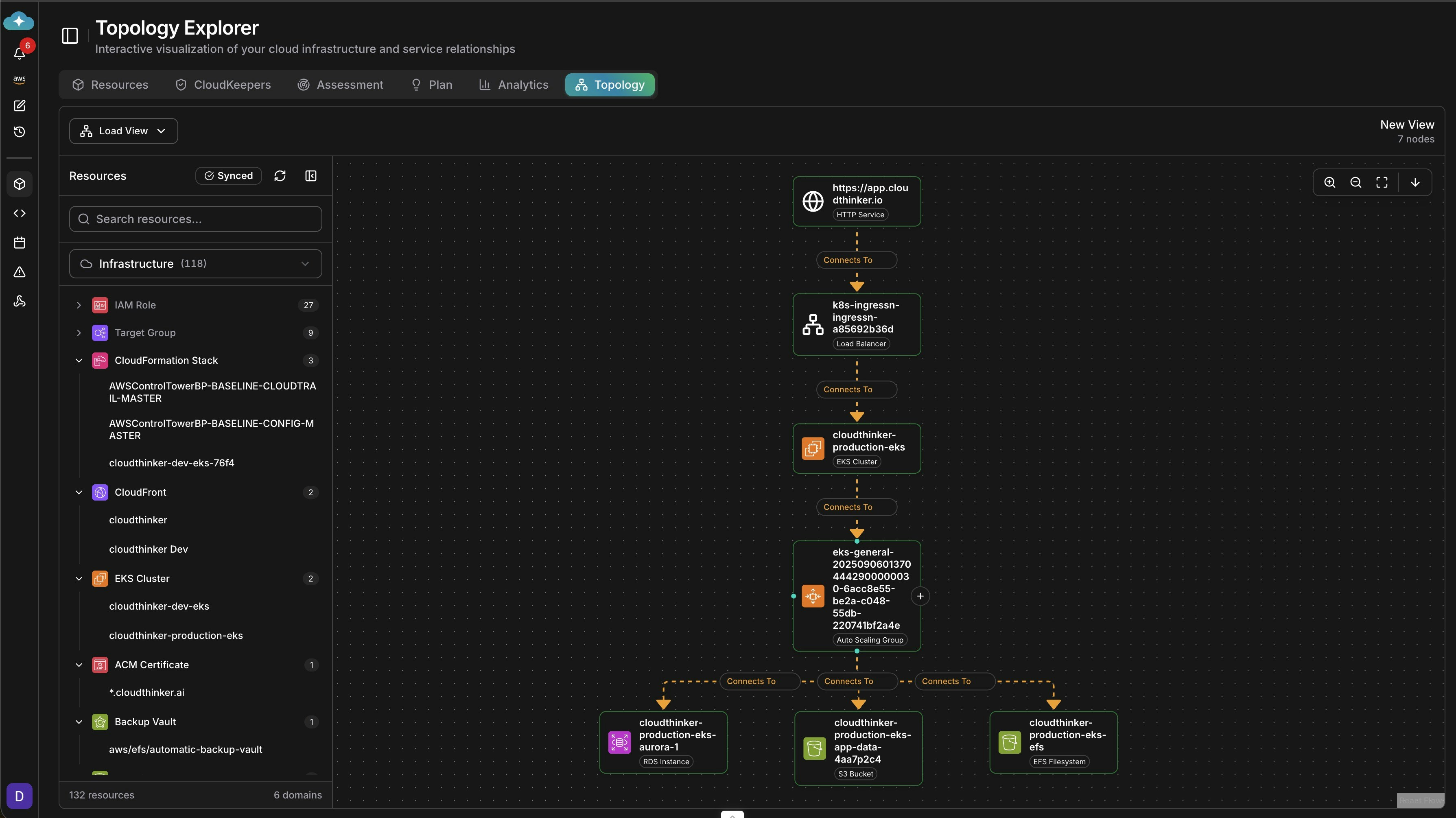
Topology
Live dependency map of your infrastructure — trace service relationships for faster incident root cause analysis
CloudKeepers
Autonomous CostOps and SecurityOps pilots that run 24/7 — catch drift, waste, and misconfigurations before they become incidents
Assessment
Automated Well-Architected assessment across all 6 pillars — findings with implementation steps, not just scores
Analytics
Unified health, performance, and cost signals correlated across all connected clouds
Plan
Turn assessment findings and agent recommendations into tracked, actionable work items
How the Pieces Fit Together
Discover
Resources continuously scans your connected cloud accounts and builds a live inventory of everything running — EC2, RDS, Lambda, GKE, Azure VMs, and 58+ resource types. Nothing is invisible.
Map
Topology builds a live dependency graph from your discovered resources — showing which services call which databases, which load balancers front which clusters, and what the blast radius of any failure would be.
Monitor continuously
CloudKeepers runs autonomous CostOps and SecurityOps pilots on a daily schedule — surfacing new drift, waste, and misconfigurations with plain-language findings and remediation playbooks.
Assess deeply
Assessment runs an automated Well-Architected review across Cost, Security, Reliability, Performance, Operational Excellence, and Sustainability — producing prioritized findings with implementation steps.
Analyze trends
Analytics correlates utilization, performance, and cost signals across all clouds — answering questions like “is this latency spike cost-related or resource-contention-related?” without switching tools.
Track and act
Plan captures findings from Assessments and CloudKeepers into a tracked work list — so recommendations move from identified to implemented with approval workflows and audit trails.
The Agents Behind Infrastructure
| Agent | Infrastructure Role |
|---|---|
| Alex | Cost analysis, right-sizing, reserved capacity, multi-cloud optimization |
| Oliver | Security posture, IAM audits, compliance evidence, misconfiguration detection |
| Kai | Kubernetes cluster health, pod efficiency, autoscaling, node optimization |
| Tony | Database performance, query optimization, connection pool analysis |
| Anna | Cross-domain coordination — combines findings from all agents into unified reports |
Quick Start
What’s Next
Connect Your Cloud
Link AWS, GCP, Azure, Kubernetes, and databases to activate all infrastructure capabilities
CloudKeepers
Start with continuous autonomous guardrails — the fastest path to ongoing visibility
Cost Optimization
Deep dive into the cost analysis and recommendation engine
Incident Response
Use topology and analytics together for faster root cause analysis during incidents