

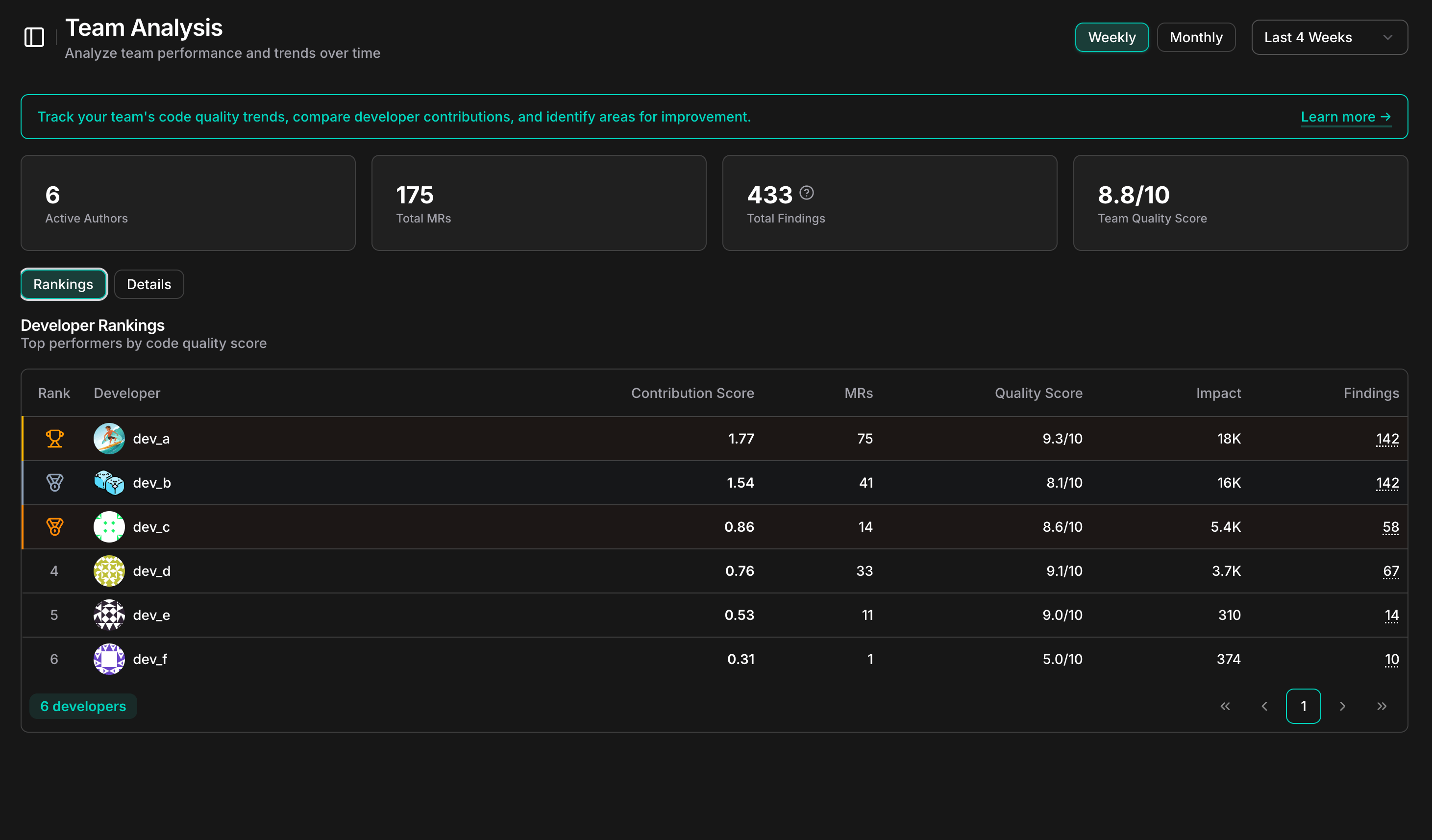
Why the leaderboard
- Team-relative scoring — both metrics are normalized against your own team’s average, so scores stay meaningful in your context
- Balanced assessment — quality and impact contribute equally (50/50), so high-volume output can’t mask low-quality work
- Fair comparison — large refactors count proportionally more than trivial changes
- Quality incentives — the 1–10 Quality Score turns code review into a positive feedback loop
- Diagnostic, not just a ranking — it surfaces workload imbalances and quality trends that PR counts alone don’t show
Quality score
Each PR receives a Quality Score on a 1–10 scale. The score starts at 10 and is reduced by the number and severity of findings — critical issues carry a higher penalty than low-severity ones. The Team Quality Score shown on the dashboard is the average across all developers.Core formula
- Normalized Quality Score = Author’s Average Quality Score / Team Quality Score
- Normalized Impact Score = Author’s Total Impact / Team Average Impact
A score of exactly 1.0 means the developer sits exactly at the team average.
Impact calculation
Each merge request’s impact score measures the complexity of the change:
The impact formula is derived from the Oobeya GitWiser Coding Impact Score methodology.
Example calculation
Team data:
Team averages:
- Team Quality Score = (8.5 + 7.2 + 9.0) / 3 = 8.23
- Team Avg Impact = (450 + 280 + 120) / 3 = 283.33
- Normalized Quality = 8.5 / 8.23 = 1.03
- Normalized Impact = 450 / 283.33 = 1.59
- Contribution Score = (1.03 + 1.59) / 2 = 1.31
Reading the leaderboard
Use the score combinations as a diagnostic for engineering health, not just a ranking:Related
Skill matrix
See per-developer proficiency across Security, Performance, Correctness, and Patterns domains
Code review analytics
Track code review trends, developer performance, and team health over time