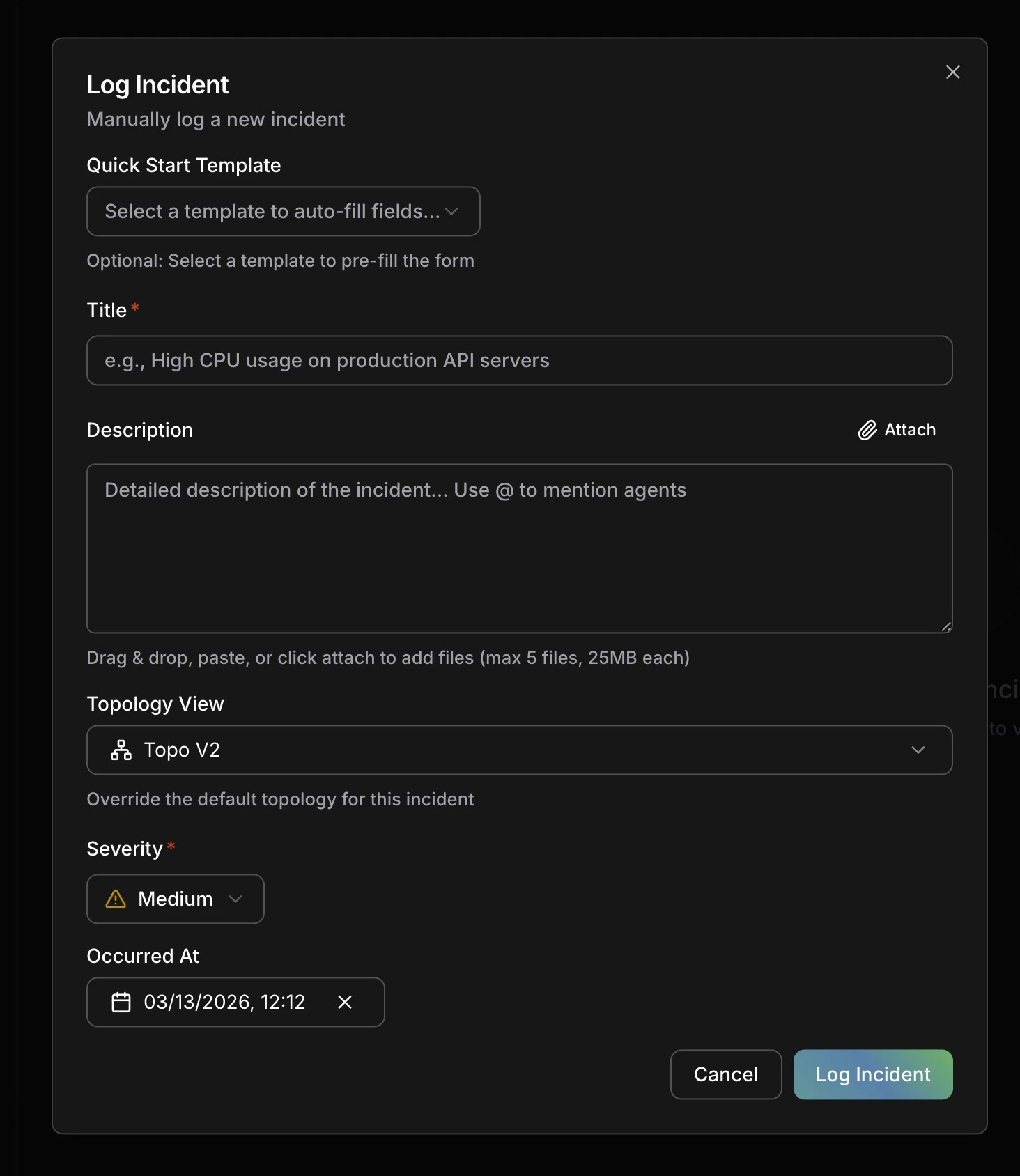
Not all incidents originate from monitoring platforms. When you observe issues directly, receive customer reports, or need to test the RCA workflow before configuring webhooks, manual incident creation provides immediate access to CloudThinker’s AI-powered investigation capabilities. Manual logging ensures every issue—whether detected by automated alerts or human observation—receives structured tracking and systematic root cause analysis.

Creating an Incident

Manual incident creation form with title, description, severity, and affected services fields

Manual incident creation form

Required Fields

Title
  • Concise summary of the incident (e.g., “API Gateway 503 errors in production”)
  • Appears in incident list and notifications
  • Used by AI agents to understand incident scope
Description
  • Detailed context about what’s happening
  • Observable symptoms and customer impact
  • Timeline of events if known
  • Any initial troubleshooting steps already attempted
Severity
  • Critical: Complete service outage, data loss, or security breach
  • High: Major functionality degraded, significant customer impact
  • Medium: Partial functionality affected, workarounds available
  • Low: Minor issues, minimal customer impact
Affected Services (optional)
  • Select from your topology map
  • Helps RCA agents prioritize investigation scope
  • Determines which specialized agents are activated
  • Can be updated after investigation reveals additional impact

What Happens Next

Once saved, CloudThinker automatically:
  1. Queues RCA Task: AI investigation begins in background within seconds
  2. Activates Agents: Specialized agents (Alex, Tony, Kai, Oliver) analyze your infrastructure based on affected services
  3. Builds Timeline: Investigation findings logged in real-time with hypothesis tracking
  4. Identifies Root Cause: Hypothesis-driven analysis with structured evidence chains
  5. Suggests Remediation: Actionable steps prioritized by impact and urgency
Track progress in the Root Cause Analysis timeline, where you’ll see agents gather context, test hypotheses, and build evidence chains.

When to Use Manual vs Webhook Creation

ScenarioRecommended Method
Monitoring platform alertsWebhook Integrations
Customer-reported issuesManual Logging
Testing RCA workflowManual Logging
Ad-hoc investigationsManual Logging
Proactive health checksManual Logging
Observed degradation (pre-alert)Manual Logging

Next Steps